
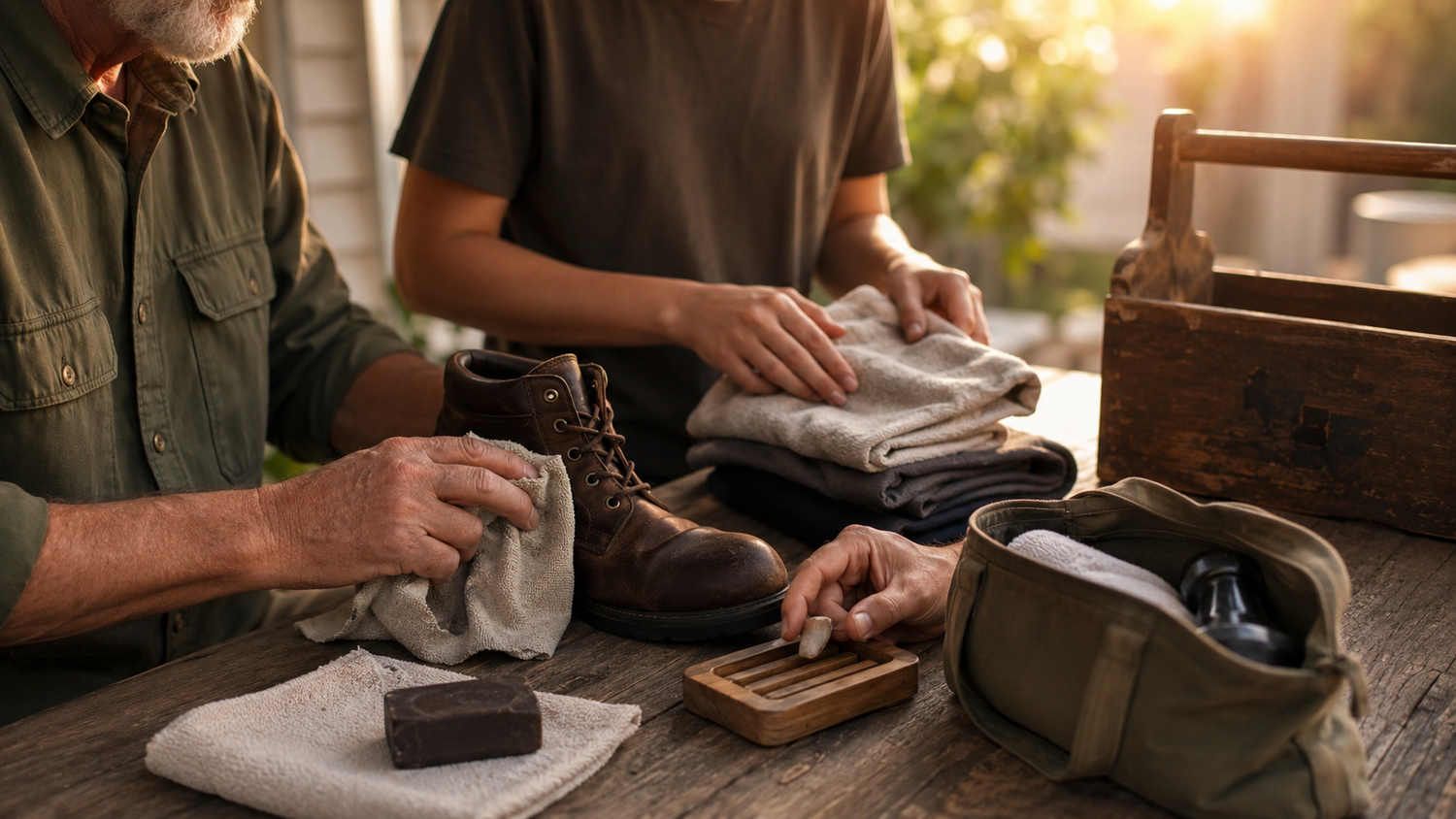
Most everyday routines have a family history.
Maybe somebody taught you to clean tools before putting them away. Maybe towels were always hung properly because damp things did not belong in piles. Maybe you learned to polish boots, mend clothing, pack carefully, wash before dinner, or leave a place better than you found it.
Perhaps you learned the opposite—because nobody had the time, tools, stability, or example to teach it.
Either way, ordinary habits tell stories about where we came from and what we choose to carry forward.
Care is often passed down through small actions
Family lessons do not always arrive as speeches.
They arrive as repetition:
- Wash your hands before eating.
- Put the tool back where it belongs.
- Do not waste what can be repaired.
- Hang the towel.
- Clean your boots before entering.
- Pack tomorrow’s things tonight.
These routines may look ordinary. Over time, they become a kind of practical inheritance.
Ask where your habits came from
Think about one routine you perform automatically.
Who taught it to you? Was it a parent, grandparent, coach, neighbor, teacher, military leader, employer, friend, or spouse?
Was the lesson spoken directly, or did you learn by watching?
The answers can reveal how much of daily life is communal rather than invented alone.
Preserve useful knowledge deliberately
Some practical knowledge disappears because everyone assumes somebody else already knows it.
Teach the next person how to:
- Do a basic load of laundry
- Pack a toiletry bag
- Care for work boots
- Store soap so it can dry
- Clean a bathroom without creating a chemical event
- Prepare clean clothes for travel
- Maintain a simple grooming routine
Do not wait until a teenager is leaving home to reveal that towels require air.
Respect routines that differ from yours
Families, cultures, communities, and individuals organize daily care in different ways.
What seems obvious in one household may be unfamiliar in another. Different does not automatically mean careless.
Be curious before becoming critical. Ask how people learned, what resources they had, and what the routine is intended to accomplish.
Keep what works and improve what did not
Honoring where you came from does not require repeating every habit exactly.
You can preserve the useful parts and change the ones that created shame, waste, confusion, or unnecessary difficulty.
For example:
- Keep the expectation of cleanliness, but remove humiliation.
- Keep the habit of repairing things, but recognize when replacement is safer.
- Keep family responsibility, but distribute the work more fairly.
- Keep practical standards, but explain the reasons behind them.
Turn one routine into shared time
Choose a small task and teach it alongside someone:
- Fold towels together.
- Clean and store tools.
- Pack for a trip.
- Organize a bathroom drawer.
- Prepare a hygiene donation kit.
- Wash the car and empty its cleanup kit.
Practical work creates space for stories. People often talk more easily when their hands are occupied.
Daily care can communicate dignity
Soap, clean clothes, maintained tools, and orderly spaces are ordinary things.
They can also say: this person matters, this home matters, this work matters, and tomorrow deserves preparation.
The routine does not need to be perfect to carry meaning.
The Rub take: somebody taught you something useful. Pass it on without the lecture voice.
A practical addition to a well-kept bathroom routine, The Rub Rest helps bar soap dry between uses so it stays cleaner and lasts longer. The Rub Rest Soap Saver