
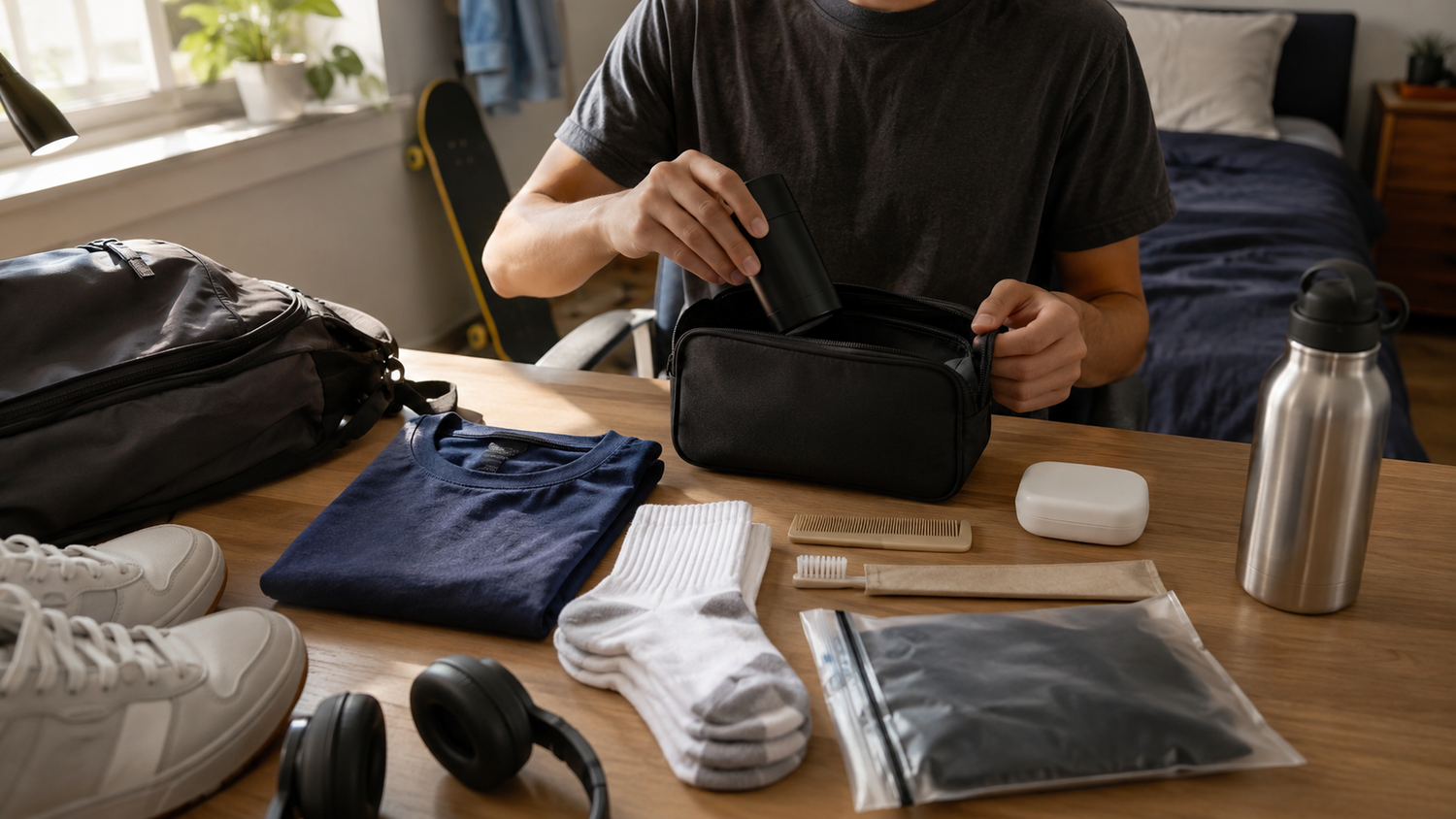
Growing up includes learning several important truths.
You have to charge your own phone. Clean socks do not regenerate inside drawers. A gym bag will not empty itself. And eventually, your personal hygiene becomes your responsibility instead of a household-wide reminder campaign.
A small school-day hygiene kit is a practical step toward that independence.
It is not an emergency embarrassment bag. It is simply a backup system for long days, sports, activities, unexpected plans, summer heat, and normal human existence.
Start with school rules
Before packing anything, check what the school allows students to carry.
Policies may vary for liquids, aerosols, medications, grooming tools, or other personal-care products.
The kit should solve problems, not create a meeting with administration.
Deodorant
For teens who use deodorant, a backup stick can be useful after sports, physical education, outdoor activities, or a long hot day.
Use it appropriately. Ideally, deodorant goes onto clean, dry underarms rather than becoming another layer over heavy sweat.
If a proper wash is available after athletics, wash, dry, apply deodorant, and change into a clean shirt.
A clean T-shirt
This may be the most valuable item in the kit.
Spills happen. Sweat happens. Art projects happen. Lunch sometimes develops ambitions.
A clean neutral shirt can rescue the rest of a school day without much drama.
Clean socks
Students involved in sports, marching band, outdoor activities, or long school days may appreciate clean socks.
Wet or heavily sweaty socks should go into a separate bag rather than moving directly into the backpack beside homework and granola bars.
A small grooming tool
A comb, brush, hair tie, or other simple item appropriate to the student can help after sports, helmets, wind, or whatever happened during second period.
You do not need a professional styling studio in a pencil pouch.
Basic dental backup
Depending on school rules and the student’s routine, a travel toothbrush, toothpaste, or floss may be useful—especially for students with activities extending well past the normal school day.
Keep it protected and separate from used clothing.
A bag for dirty items
This is the part many people forget.
If the kit includes clean clothing, it also needs somewhere for the used clothing to go.
A simple sealable or washable pouch keeps damp socks and shirts from spending the afternoon making friends with textbooks.
Travel soap when facilities make it useful
For sports, camps, travel, or locker-room showers, a small soap setup can make sense.
If using bar soap, place it in a travel dish that allows the bar to dry once you return home. Do not seal a wet bar indefinitely.
Teach the student to maintain the kit
This is the important part.
A parent can assemble the perfect kit on Sunday, but if the student never empties it, Tuesday eventually becomes biological research.
After using anything:
- Remove dirty clothing.
- Wash used towels or cloths.
- Dry wet containers.
- Replace the clean shirt and socks.
- Check deodorant and other supplies.
- Put the kit back in the bag.
Keep the conversation matter-of-fact
Personal hygiene does not need to be taught through teasing or embarrassment.
Say what the routine is, explain why it helps, provide the supplies, and give teenagers increasing responsibility for maintaining them.
The goal is not to make someone hyper-aware of how they smell or look. The goal is competence.
Independence is built from small systems
Knowing how to manage your body, clothes, supplies, and belongings is part of growing up.
A hygiene kit is one tiny system. But learning to maintain it reinforces a much larger idea:
You can notice what you need, prepare for it, use it responsibly, and reset it afterward.
The Rub take: raising capable humans includes teaching them what happens to the gym socks.
A practical pairing for a teen hygiene kit: one natural bar soap for showers and one baking-soda-free deodorant for school days, sports, and long afternoons. Standard Bundle | Soap & Deodorant Set