
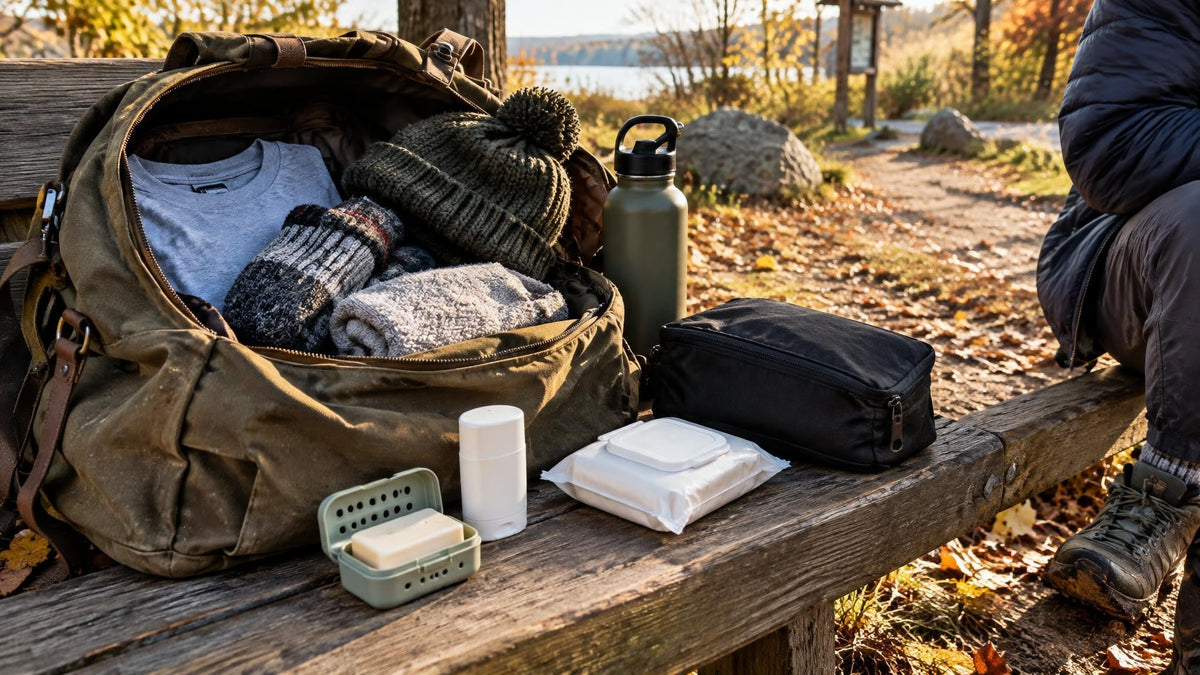
Every outdoor day starts with confidence. You check the weather, grab a jacket, and tell yourself you will be back before the cold gets serious.
Then the wind changes, your gloves get damp, somebody spills cocoa on a sleeve, and your once-proud outfit begins negotiating with the laws of thermodynamics.
November 7 is National Play Outside Day, which is a fine excuse to spend a few hours at a park, trail, ball field, backyard, or anywhere else that is not the couch. The trick is bringing enough personal-care gear to stay comfortable without packing like you are crossing a mountain range to retrieve a lost sandwich.
Here is what belongs in a cold-weather outdoor day bag—and what can stay home.
Start with the one-bag rule
Your bag should solve likely problems, not every problem ever recorded by civilization.
For a few hours outside, think in four categories:
- Something dry to wear
- Something useful for washing or wiping
- Something that manages sweat and cold-weather layers
- Something that keeps damp items from spreading their opinions
If an item does not fit one of those jobs, ask whether it is genuinely useful or whether you are simply afraid of being defeated by a slightly uncomfortable afternoon.
Pack one real clothing backup
A spare shirt is the most useful item in the bag because weather has a sense of humor. You may sweat while walking, get splashed near a puddle, sit on a damp bench, or discover that your “water-resistant” jacket has a very flexible definition of resistant.
Choose a lightweight shirt that can pack down small. A spare pair of socks is also worth the space, especially if you will be outside around wet grass, mud, or children carrying beverages with the confidence of tiny bartenders.
You do not need a complete second wardrobe. One shirt and one pair of socks solve more problems than three emergency scarves and a hat you refuse to wear because it makes your hair look “weird.”
Use a towel for the right job
A small clean towel earns its place in a cold-weather day bag. It can dry hands, wipe a wet seat, handle a spilled drink, or give you a barrier between your clean clothes and a suspicious picnic table.
Choose a compact towel that dries reasonably well. Avoid packing a thick bath towel unless your outdoor activity involves an actual bath, in which case we have several follow-up questions.
Keep the towel separate from damp clothing. A towel that starts dry can become useful. A towel that gets trapped against wet socks becomes part of the investigation.
Bring a simple wash option
Outdoor days create small messes: dirt under fingernails, sticky food on fingers, sunscreen residue, muddy palms, and the mysterious film that appears after handling playground equipment or a picnic cooler.
Pack hand wipes or a small amount of hand soap for situations where a sink is available. If you are heading somewhere with a restroom or wash station, a compact bar of soap in a ventilated travel container can be a practical option. Let the bar drain when possible, and do not seal it up soaking wet for the entire afternoon.
The goal is not to turn the trailhead into a luxury spa. It is simply to make it easier to wash before eating, after handling messy gear, and before climbing back into the family vehicle.
Do not forget deodorant, but pack it intelligently
Cold air can make people forget that they are still moving. Layers trap warmth, brisk walking creates sweat, and heavy jackets hold onto whatever happened underneath them.
A small deodorant is useful if you expect a long day, a crowded car ride, or an indoor stop afterward. Apply it to clean, dry underarms according to the product directions. Do not apply it over a sweaty shirt and hope the fabric will negotiate a peace treaty.
Also remember that deodorant is not a substitute for washing. Clean body, dry skin, appropriate deodorant, clean shirt. That is the sequence. It is not complicated enough to require a committee.
Give damp gear somewhere to go
The most important bag accessory may be an ordinary reusable waterproof pouch or plastic bag for wet socks, muddy gloves, or a shirt that has lost its battle with the weather.
Contain damp items as soon as you remove them. This keeps them away from your towel, spare shirt, snacks, and the interior of your vehicle. The bag is transportation, not fermentation.
When you get home, empty the pouch immediately. Hang wet clothing, open the shoes, and let everything dry according to the manufacturer’s care instructions. Do not leave damp gear zipped inside the bag until next weekend. That is how a pleasant afternoon becomes a smell with a backstory.
Keep snacks and grooming supplies separate
Outdoor bags often become a single-compartment parliament where granola bars, gloves, wipes, and deodorant all debate whose crumbs belong to whom.
Use separate pouches when possible. Keep food in one area, personal-care items in another, and damp gear in its own containment zone. This makes the bag easier to use and prevents your spare shirt from smelling like trail mix before it ever meets your torso.
A small zippered pouch can hold wipes, lip balm, deodorant, tissues, and any personal items you actually use. Keep the pouch easy to reach. Emergency supplies hidden beneath a jacket, a thermos, and three abandoned receipts are not emergency supplies. They are archaeological evidence.
What can stay home?
Leave behind full-size bottles, multiple fragrances, excessive grooming tools, and anything you are bringing only because it feels responsible.
You do not need six scent options for a three-hour walk. You do not need a complete shower shelf in a backpack. You do not need a separate product for every possible emotional state your hair may experience.
Pack for the activity, the weather, and the people involved. A spare layer, a towel, a wash option, deodorant, and a damp-gear pouch will usually beat a heavy bag full of products you never touch.
The five-minute arrival check
When you return, do five things before the bag disappears into a closet:
- Remove wet clothing and shoes.
- Hang anything that can dry safely.
- Put the towel somewhere it can air out.
- Wipe or rinse reusable items according to their care instructions.
- Restock the spare shirt, socks, wash supplies, and deodorant.
This is not a dramatic household reset. It is simply closing the loop while the day is still fresh in your mind. Future you will appreciate not discovering November mud on the bottom of the bag in January.
For the home base of your outdoor-day gear, The Rub Rest helps keep a bar of soap elevated with airflow and drainage between uses, which makes it a useful companion to a bag that is supposed to carry clean gear—not a damp little ecosystem. Pack smart, play outside, and let the mud stay where it belongs: on the shoes.